The trip of a lifetime, planned right
Prepare for your
Route 66 trip.
There's plenty to be said for just jumping in the car and hitting the road. But a little planning ensures you make the most of the Mother Road. Here's everything you need to know before you go.
16:10 · approx 1600 × 1000 px
Question one
How long do you need?
The route runs 2,448 miles (3,940 km) across eight states. You could technically drive it in about 35 hours. But to enjoy what the road has to offer, two to three weeks is the sweet spot. Here are six proven ways to do it.
Explorers & Photographers
For people who want to see every brick
If you're thorough, love every neon sign and old alignment, and stop for pictures, three weeks is your number. Starting and stopping takes time: a "short" photo stop is rarely under twenty minutes, and golden hour won't wait. This pace gives you around 120 miles (190 km) a day, with slack for detours, museums and that ghost town you didn't plan on.
The pace serious documenters actually need.
Long & Languid
For people who want it all
The dream of every Mother Road adventurer: two weeks means you can find a seat and an extra piece of pie in an iconic diner, revel in the view, and stay an extra night anywhere that touches your soul.
Only ~170 miles (275 km) a day, not even four hours of driving.
The Whole Road, Briskly
For full-route drivers on a schedule
Yes, you do the full route. Ten days means around 245 miles (395 km) a day: on the road by nine, parked by five, with time for three or four proper stops in between. Pick your must-sees each morning, book your motels ahead, and save the lingering for the icons you care most about.
The full experience, minus the second piece of pie.
Cluster Hopping
For targeted enjoyment
There's usually an interstate not far from Route 66. Use it to link the great clusters of original road, then give each cluster your full attention: Chicago to Springfield, Springfield MO to Joplin, western Oklahoma, Tucumcari to Gallup, Seligman to Topock.
Maximum icons, zero rushed stops.
One Great Stretch
For doing less, better
With under a week, it's best to focus on a single stretch and do it justice rather than sprint the whole road. Classic picks: California to Arizona for desert and neon, St. Louis to Chicago for diners and Americana, or St. Louis to Flagstaff for the figurative and literal heart of the route.
Save the rest of the road for next time. It'll wait.
Weekends Away
For short Route 66–themed escapes
Cut out of work early on Friday and drive a section properly: Chicago to Springfield, Illinois; Oklahoma City to Tulsa; Albuquerque to Winslow; or Los Angeles to Kingman.
Do the whole route one weekend at a time.
Question two
Which direction?
There's no wrong way down the Mother Road, but the two directions feel like different trips.
Westbound · the classic
Chicago → Santa Monica
This is the direction of the Dust Bowl migrants, the song, and nearly every guidebook ever written. Attractions come up in the order the books describe them, historic signage assumes it, and the whole trip builds toward the payoff: desert light, the Pacific, and the "End of the Trail" sign on Santa Monica Pier. Hard to beat as a finale.
- First time on the route? Go west.
- One quirk: afternoon sun in your eyes on long western stretches. Pack good sunglasses.
Eastbound · the contrarian
Santa Monica → Chicago
Follow the lead of the old-time truckers who hauled loads east from the Port of Los Angeles, with the bright lights of Chicago as your goal. You'll meet the famous stops before the crowds coming the other way, and mornings put the sun behind you.
- Outside of summer, dress more warmly as you go.
- Open-jaw flights (arrive one end, leave from the other) cost little more than round-trips, so either direction works.
Question three
Which ride?
Your own car, a rental, an RV, a Harley or an EV: each is a different trip. Whatever you choose, make sure you get unlimited mileage.
From $25–75/day · $125–500/week
Rental car
The classic choice. You'll need a major credit card (not debit), a valid license, and to be at least 25; some companies rent from 21 with a daily surcharge. Enterprise, Budget, Hertz and Avis have centers at airports, in cities and mid-sized towns along the route.
- "Unlimited mileage" is standard, but confirm it. A Route 66 trip is expensive without it.
- Ask for the total cost including all taxes and fees; they vary by state.
- Decline the fuel purchase option unless you'll return it empty.
- Discounts via auto clubs, credit cards and airlines, so shop around before you book.
Van campers to full cruisers
RV / campervan
From van-based campers to enormous custom cruisers with satellite TV and full kitchens. Beware: mileage is usually charged separately, insurance is hefty, and one-way charges can be extreme. Read the fine print and shop around.
- Camping and parking rules vary widely along the route. Always check locally before settling in.
- Campgrounds that welcome RVs are easy to find, from about $15/night.
$200+/day for a Harley tourer
Motorcycle
The most romantic way to feel the road, and the priciest: two wheels cost more than four, often much more. Specialist companies arrange one-way rentals such as Chicago to LA.
- You'll need a motorcycle license from your home country or state.
- Most car-rental considerations (age, credit card, insurance) apply here too.
Often priced with the cheapest rentals
Electric vehicle
Major rental firms all rent EVs, an undeniably green alternative. Charging options abound along Route 66, usually at chain hotels and interstate interchanges, though stations remain far less common than gas stations.
- Use PlugShare, ChargePoint and Electrify America apps to find charging points.
- Familiarize yourself with the car in advance. Rental companies seldom provide instructions.
The cheapest option of all
Your own car
If you have your own vehicle, there's little stopping you from heading straight out. Keep your registration and insurance documents in the vehicle, get a checkup before you leave, and fill up whenever you can. It's not unusual to drive an hour without passing a station.
For the most committed only
Bicycle (the brave option)
Biking the whole route is for the truly dedicated: various stretches are narrow, hilly and ill-suited to cyclists, some are busy with traffic, and in places the only alternative is an interstate that doesn't allow bikes. What works well: short stretches and scenic country lanes.
Don't skip this one
Insurance
That great rental deal won't look so good if you also spend $30 a day on insurance. Agency staff are incentivized to sell an alphabet soup of add-ons; Collision Damage Waiver (CDW) and Loss Damage Waiver (LDW) are the most common. Credit cards and your own policy may already cover you, but check carefully before you arrive at the counter. In an accident, dial 911.
For international drivers
License & IDP
Foreign visitors can legally drive in the US for up to 12 months on their home license. An International Driving Permit (IDP) adds credibility with US traffic police, especially if your license has no photo or isn't in English. Always carry both.
16:10 · approx 1600 × 1000 px
Question four
When to go?
Route 66 is a year-round road, but the seasons change the trip. April–May and September–October combine the best weather with reduced prices.
Mar – May
the sweet spotSpring is a lovely time to go. Beginning in April, most everything is open, temperatures are mild and wildflowers bloom. One caution: tornado season peaks in May–June in Missouri, Texas, Oklahoma and Kansas. Keep an eye on forecasts.
Jun – Aug
peak seasonBook coveted motels in advance and prepare for crowds. Balmy nights mean sitting outside under the stars, but daytime desert temps are dangerous. Extreme heat can be deadly in the Southwest and Mojave (up to 130°F / 54°C).
Sep – Nov
golden & calmAutumn colors light up the Midwest and the hills further west glow in the sun. Much is open through October, and outside summer weekends you don't need to worry much about booking ahead.
Dec – Feb
quiet, with caveatsWinter days are short and snow can happen nearly anywhere but California. Storms can close roads from Illinois to Arizona, and some rural attractions shut for the season. Don't assume winter will be cheaper, but you'll have the road to yourself.
Question five
What does it cost?
A budget of $350–400 per day for two people won't leave you feeling scrimped. Budget a bit more for Chicago and LA; with economizing, two can do the road well under $300 a day.
A day on Route 66
typical costs · two adults
| Coffee & snacks | $20 |
| Museum entry | $12 |
| Souvenir | $20 |
| Lunch at a roadside diner | $30 |
| Vintage motel room | $120 |
| Dinner at a local restaurant | $50 |
| Gas per day | $60 |
| Car hire per day | $60 |
| Total per day | $372 |
Tipping isn't optional
it's how service people earn their living in the US
Money dos & don'ts
- Let your bank know you'll be traveling.
- Pay contactless. Cards work at 90%+ of establishments; keep cash for tips and quirky shops.
- Convert to your home currency at ATMs or checkout. You'll pay fees twice.
- Forget sales tax. It's added at the till and varies by state and region.
Stretch the budget
Ways to save
- Travel shoulder season. April, May, September and October mean lower room rates and the best weather.
- Book indie motels direct. Their own website or a phone call often beats the big booking sites.
- Picnic your lunches. Stock up at grocery stores and save the restaurant budget for a proper diner dinner.
- Camp a night or two. $15 under the stars instead of $120 in a room adds up fast.
- Rent smart. Book early, re-check prices before you fly, and skip the airport surcharge by picking up downtown.
- Share the ride. Gas, room and rental split two or four ways changes the math completely.
- Remember the best of Route 66 is free. Neon at dusk, murals, Muffler Men, ghost towns and the view cost nothing.
- Ask about breakfast and fridges. A room with both quietly saves $20–30 a day.
Question six
Where to stay?
Motels and Route 66 have a symbiotic relationship going back decades. There were once hundreds along the route; today, a beautiful few survive.
Vintage motels · from $60/night
The real deal
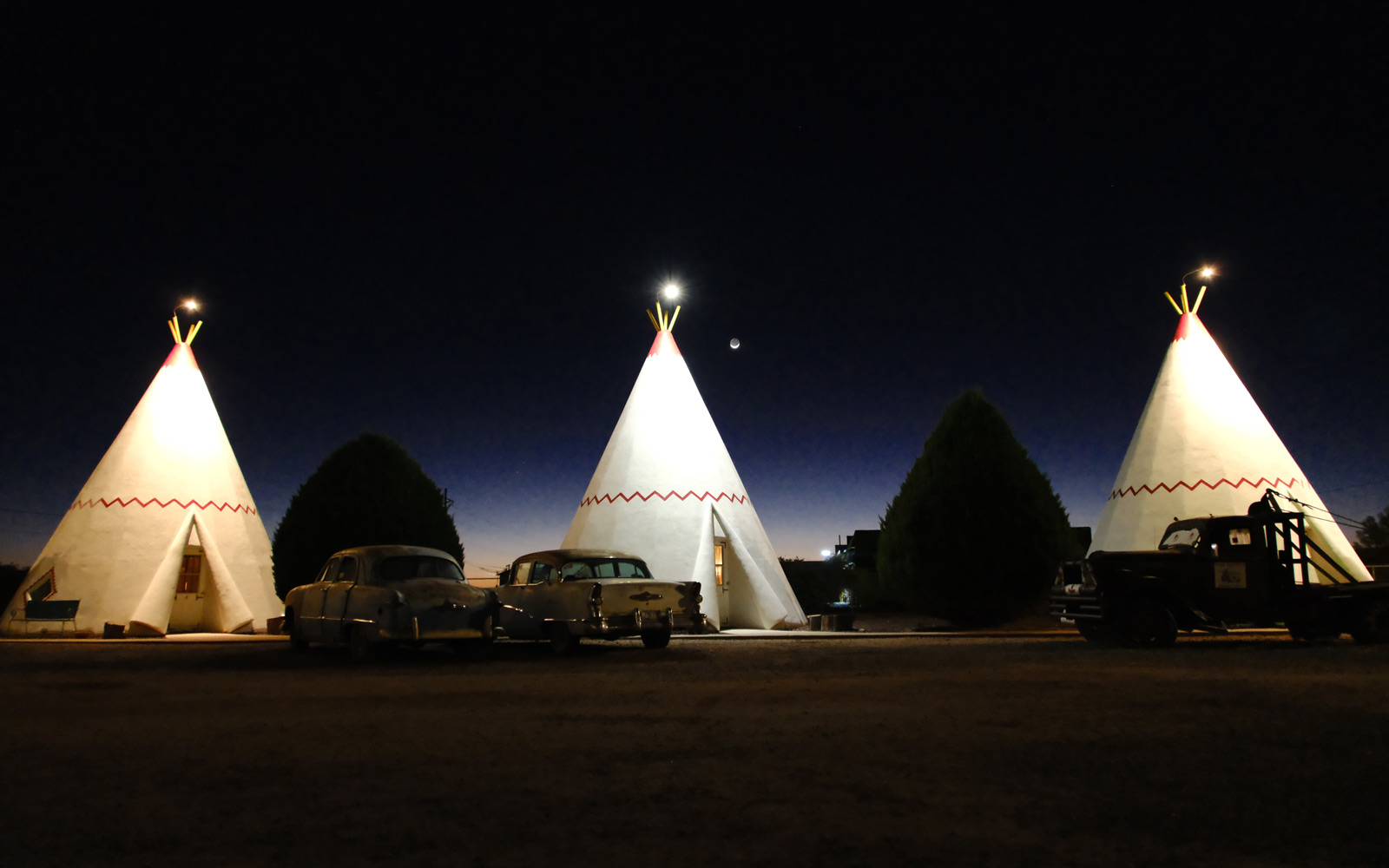
Mother Road icons like the Munger Moss Motel (Lebanon, MO), the Blue Swallow (Tucumcari, NM) and the Wigwam Motel (Holbrook, AZ) are beautifully restored classics, and must be booked in advance. Others barely hang on, so look for recent reviews, and ask to see a room before committing. One perk: parking right in front of your room.
Chain & city hotels · from $120/night
The reliable option
Chain hotels cluster around interstate interchanges, reliable but similar from brand to brand. More lavish properties await in Chicago, St. Louis, Tulsa, Oklahoma City, Albuquerque and LA. Wi-fi is essentially universal; pools are welcome after a summer day on the road.
Campgrounds · from $15/night
Under the stars
Campgrounds are found in and near state parks and national forests along the whole route, and most welcome RVs. Regulations vary widely across the regions Route 66 traverses, so check locally before settling in for the night.
Traveling with kids? Most motels have rooms with two beds, rollaways or cribs, and some offer "kids stay free" up to 12 or even 18.
16:10 · approx 1600 × 1000 px
Question seven
On the road.
Around 85% of the original highway is still drivable, but GPS often doesn't recognize Route 66 as a continuous path. A little know-how goes a long way.
Mapping your journey
The old road moved many times over its 100 years, which is why generic map apps get lost. Route 66 Logbook maps every Route 66 alignment that ever existed, the only app that does, so you always know whether you're on the 1926 dirt-era road, the post-war four-lane or something in between.
Whatever you navigate with, download offline maps while you're on wi-fi. It saves bandwidth and keeps maps working when there's no signal, which is common in the desert.
Rules of the road
- Drive on the right. Seat belts required.
- Rural speed limits range 55–75 mph (90–120 km/h); towns and cities 25–35 mph (40–55 km/h). Limits are commonly enforced.
- Right turns on red are allowed unless signed otherwise.
- Never pass a school bus with flashing lights; pull over for emergency vehicles.
- Holding a phone while driving is illegal in Arizona, California, Illinois and Missouri.
- Blood alcohol limit: 0.08%. Never drink and drive.
- Breakdown? Move off the road, hazards on, call roadside assistance. Emergencies: 911.
Check conditions
State transportation departments provide road conditions via the nationwide 511 system (search your state's name and "511"). Winter storms, flash floods, potholes and mountain weather, particularly in Arizona and New Mexico, can make travel difficult, so check before heading out.
Apps worth having
- Route 66 Logbook: 800+ living, community-updated stops, every historic alignment, and a logbook that writes itself.
- GasBuddy: nearby gas stations and the best deals on gas.
- what3words: helps 911 teams find you in emergencies, especially rural areas.
- PlugShare / ChargePoint / Electrify America: EV charging points.
Safety & weather
For the Route 66 traveler, petty theft is the biggest concern: lock valuables in your trunk before you set out for the day. Tornado season (May–June, MO/TX/OK/KS) is trackable on your phone. In summer, extreme desert heat can be deadly for both humans and cars, and watch for sudden thunderstorms that flood roads. Solo travelers won't face unusual hazards; keep an eye on your phone signal on remote detours.
Travel responsibly
Go local, eat local, stay local. The whole point of Route 66 is the authentic, idiosyncratic businesses that give the route its character. Your support keeps them alive. Sign the guestbooks (they fuel grant applications), carry a refillable water container, and travel respectfully through the lands of the 25+ tribal nations along the route.
Especially for international visitors
First time in the USA?
Visas & ESTA
Visitors from 42 nations, including the UK, Australia, New Zealand, Japan and many EU countries, don't need visas for stays under 90 days, but must get ESTA approval in advance. Canadians need neither visa nor ESTA for stays under 90 days. Details: travel.state.gov.
Health insurance
Healthcare costs in the USA are extremely high. All travelers should carry a health insurance policy valid for their US travels. Without it, you're billed the full cost of any care, which can easily run to thousands, especially for ER visits.
Phones & internet
Most non-US phones work fine here, but roaming can be pricey. Check what your plan allows; you'll use mapping apps a lot. Consider a cheap eSIM with at least 5GB of data. Free wi-fi is offered in motels, hotels, cafes and many public spots.
Time zones & power
Route 66 crosses three time zones: Central, Mountain and Pacific. Daylight saving runs from the second Sunday in March to the first Sunday in November, but it's not used everywhere (looking at you, most of Arizona), so use your phone to determine local time. Electricity: 120V/60Hz, Type A/B plugs.
ID, alcohol & smoking
Carry photo ID; you may be asked for it when buying alcohol even if you're clearly over 21. Most states, including California and Illinois, are smoke-free in restaurants and bars; parts of Oklahoma and Texas are exceptions. Marijuana legality varies widely: legal in small amounts in California and Illinois, illegal in Oklahoma, Texas and elsewhere.
What to wear
In America just about anything goes, especially along Route 66. Unless you're planning nights out at stylish places in Chicago or LA, dress as casually as you like.
16:10 · approx 1600 × 1000 px