
The quieter road
Hidden gems are not always secret. Sometimes they are simply overlooked because they sit between bigger names. Route 66 is full of them: small museums with handwritten labels, restored bridges, fading gas stations, family diners, county courthouses, murals, old cabins, forgotten alignments and roadside ruins that make you pull over without knowing why. These are the places that turn a standard itinerary into your itinerary.
Why they matter
The obvious stops create the shared Route 66 story. Hidden gems create the personal one. When you talk to other travellers, everyone has a Cadillac Ranch photo. Not everyone remembers the little town where a volunteer unlocked a museum for them, or the abandoned service station glowing pink at sunset, or the mural they found behind a main street building. Those memories feel earned.
Route 66 hidden gems worth adding to your map
Some overlooked Route 66 stops are not hidden at all. They simply sit between bigger attractions, receive less attention online or require you to follow the old road instead of the interstate.
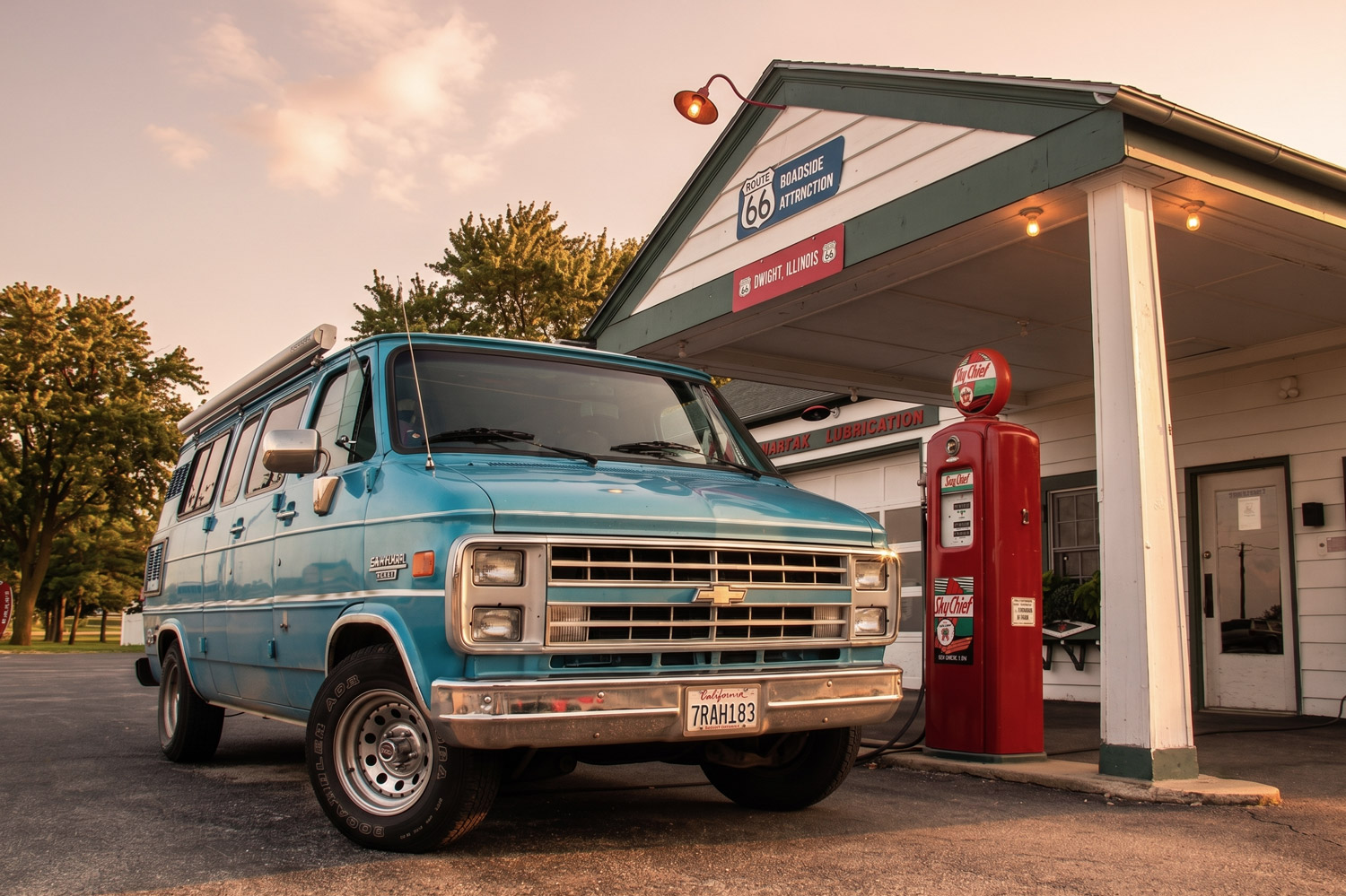
Ambler’s Texaco, Dwight, Illinois
Built in 1933, this beautifully restored filling station served motorists for decades before eventually becoming the Village of Dwight visitor centre. The old pumps, canopy and service bays make it an easy place to understand what a small Route 66 station actually looked like before service plazas and interstate exits changed the way Americans travelled.
Devil’s Elbow, Missouri
Rather than one attraction, Devil’s Elbow is a whole surviving Route 66 landscape. The old road winds through the wooded Ozarks around the Big Piney River, with historic road sections, bridges and roadside buildings still giving the area the feeling of an earlier journey through Missouri. It is the kind of place that rewards slowing down rather than checking off a single landmark.
Gary’s Gay Parita, Missouri
West of Springfield, this recreation of a historic Sinclair station is packed with old pumps, signs, vehicles and Route 66 memorabilia. The original roadside business dates back to the early Route 66 era, while the station travellers see today owes much of its character to the late Gary Turner, whose hospitality helped turn it into a beloved stop for road-trippers from around the world.
Marsh Arch Rainbow Bridge, Kansas
Kansas only gets around thirteen miles of Route 66, which makes it easy to rush through. Do not. Near Riverton, the Marsh Arch Rainbow Bridge is the last surviving bridge of its type on the Kansas stretch and one of the small pieces of road infrastructure that makes the state worth exploring rather than simply crossing.
Seaba Station, Warwick, Oklahoma
Built in 1921, five years before Route 66 was designated, Seaba Station began as a rural filling station and later became an engine rebuilding shop. Today the restored building houses a motorcycle museum, but the real attraction is the building itself: a surviving example of the businesses that were already waiting beside the road when Route 66 arrived.
The old road inside Petrified Forest National Park, Arizona
Most visitors come for the petrified wood and Painted Desert, but the park also preserves a trace of Route 66. Near the old alignment, telephone poles still follow the former roadbed and a 1932 Studebaker marks the Route 66 pullout. It is a simple stop, but one that makes it surprisingly easy to imagine the highway crossing this landscape before Interstate 40.
These places are a good reminder that a Route 66 hidden gem does not need to be secret. Sometimes it is simply a place that becomes more interesting once you know what you are looking at.
Look between towns
Some of the best discoveries happen outside the town centres. Old alignments often run beside the interstate, across farmland, through scrub, past railroad tracks or along cracked pavement where the traffic has moved on. These sections are not always dramatic, but they are powerful. You feel the difference between a road built for movement and a highway built for speed.
Talk to people
The fastest way to find hidden gems is to ask locals. Ask a motel owner what travellers miss. Ask a museum volunteer where the old road went. Ask a diner server which sign still lights up, which building used to be something else, or which side street is worth seeing. Route 66 knowledge is not only in books. It lives in people who have watched the road change.
Follow the small signs
Route 66 has many small clues: brown historical markers, hand-painted arrows, old shield signs, mural trails, preservation plaques, vintage postcards in a window, or a roadside object placed as if someone wants you to notice. Follow those clues when time allows. The road rewards curiosity, but it rarely explains itself loudly.
Hidden does not mean untouched
Be careful with the word hidden. Many places are private property, fragile ruins or businesses trying to survive. Do not trespass for a photo. Do not climb on old structures. Do not treat abandoned towns like film sets. The best travellers leave places as they found them and spend money where they can. Preservation is not an abstract idea on Route 66; it is often the difference between a place surviving and disappearing.
A few types of hidden gems
Look for old bridges, especially where the new road bypasses them. Look for independent motels that still have their original signs. Look for town museums that preserve local road history. Look for murals that tell specific stories rather than generic nostalgia. Look for original pavement, especially where the road narrows and the surface changes. Look for cemeteries, depots, courthouse squares, old theatres and family-owned cafes.
Build your own Route 66 map
A hidden gem becomes more powerful when you record why it mattered. Was it beautiful? Weird? Sad? Funny? Well-preserved? Nearly gone? Did someone tell you a story there? Did it change your understanding of a town? The act of logging these places is not just useful. It is a form of respect. Route 66 Logbook gives you one place to save that stop and the reason it stood out while the memory is still fresh.
Hidden gems are usually preservation stories
A hidden gem on Route 66 is rarely hidden by accident. Often it is a place that survived because a local family refused to let it go, a volunteer group restored it, a town repainted a mural, or a small museum gathered artefacts that would otherwise have disappeared. The National Park Service Route 66 Corridor Preservation Program has supported more than 170 cost-share projects since 2001, which is a reminder that the road's charm is maintained by work, not nostalgia alone.
Look for bridges, old roadbed, motor court layouts, service station canopies, ghost signs and small-town museums. These do not always shout for attention. Some of the best discoveries are barely more than a concrete pad, a weathered sign, a curved curb or a restored pump. They tell you how the road functioned before the big icons became souvenirs.
What makes a lesser-known stop worth logging
A good hidden gem usually does at least one of three things: it shows how people lived with the road, it preserves a piece of infrastructure, or it reveals a story that the polished travel guides skip. The Negro Motorist Green Book, first published in 1936 and continuing into the mid-1960s, is one example of why the road's hidden histories matter. For Black travellers, the open road was not equally open, and safe places to sleep, eat and buy fuel could determine whether a trip was possible.
That is why a logbook should never only rank stops by spectacle. It should also let travellers mark why a place matters: preserved, threatened, family-run, Green Book history, old alignment, local art, neon, closed but visible, or community-restored. Those categories help the road become a living archive instead of a checklist.
Take it with you in Route 66 Logbook
Route 66 Logbook helps you find and record the smaller places between the famous stops. Create a “nearly missed” habit as you travel and save the places that surprised you. Those stops may become the ones you care about most when the trip is over.
Train your eye for the small details
Hidden gems often reveal themselves through repetition. After a few days, you start noticing patterns: the old canopy shape of a gas station, the curved motel office, the ghost sign on a brick wall, the little shield painted on a kerb. Once your eye adjusts, the road becomes denser.
A hidden gem can be quiet
A hidden gem does not need to be dramatic. One of the best stops can be a quiet main street where nothing much seems to happen, except that the proportions are right and the old road still runs through the centre. Those places remind you that Route 66 was everyday infrastructure before it became legend.
Share fragile places with care
When sharing hidden gems publicly, add context rather than simply announcing a secret. Tell people how to behave, whether it is private, whether donations help, whether a business is open, or whether the place is fragile. Good travellers do not just discover places. They help protect them.